Corporate Governance
Basic Stance on Corporate Governance
With the corporate philosophy of "QUALITY FOR THE FUTURE", we have contributed to society through our rent guarantee business, which supports affluent and comfortable lifestyles. In order to continue to be needed by society and chosen by users, we will continue to provide new value and create the future with free and flexible ideas, and walk forward together with all of our stakeholders. To realize this corporate philosophy, we have established the following code of conduct.
-
Honesty and Trust
In accordance with social norms, we will act in good faith so that we can deliver reliability and security to everyone in a sincere and responsible manner.
-
Quality and Value
Through free thinking, we will act to create a level of quality and value that will become a sustainable standard for the future so that our customers will continue to choose us.
-
Change and Evolution
We are always a step ahead in thinking about the future, and instead of fearing change, we see it as an opportunity to evolve, allowing us to take quick action.
-
Challenge and Growth
Without being bound by conventional values and customs, will act to achieve growth and lead the industry by continuing to take on challenges for the future.
-
Teamwork
We will create a more open workplace where each and every employee respects one another and works as a single team to achieve even greater heights.
In order to realize our corporate philosophy of providing new value for the future through the free and vigorous activities of our employees in accordance with our Code of Conduct, we recognize that it is essential to respect the positions of our various stakeholders and to adhere to the fundamental principles of corporate governance, including transparency, fairness, promptness, and decisiveness in decision-making.
Accordingly, we position the realization of corporate governance as the core of our corporate management and strive to establish and operate a more effective and robust governance system.
Corporate Governance Structure
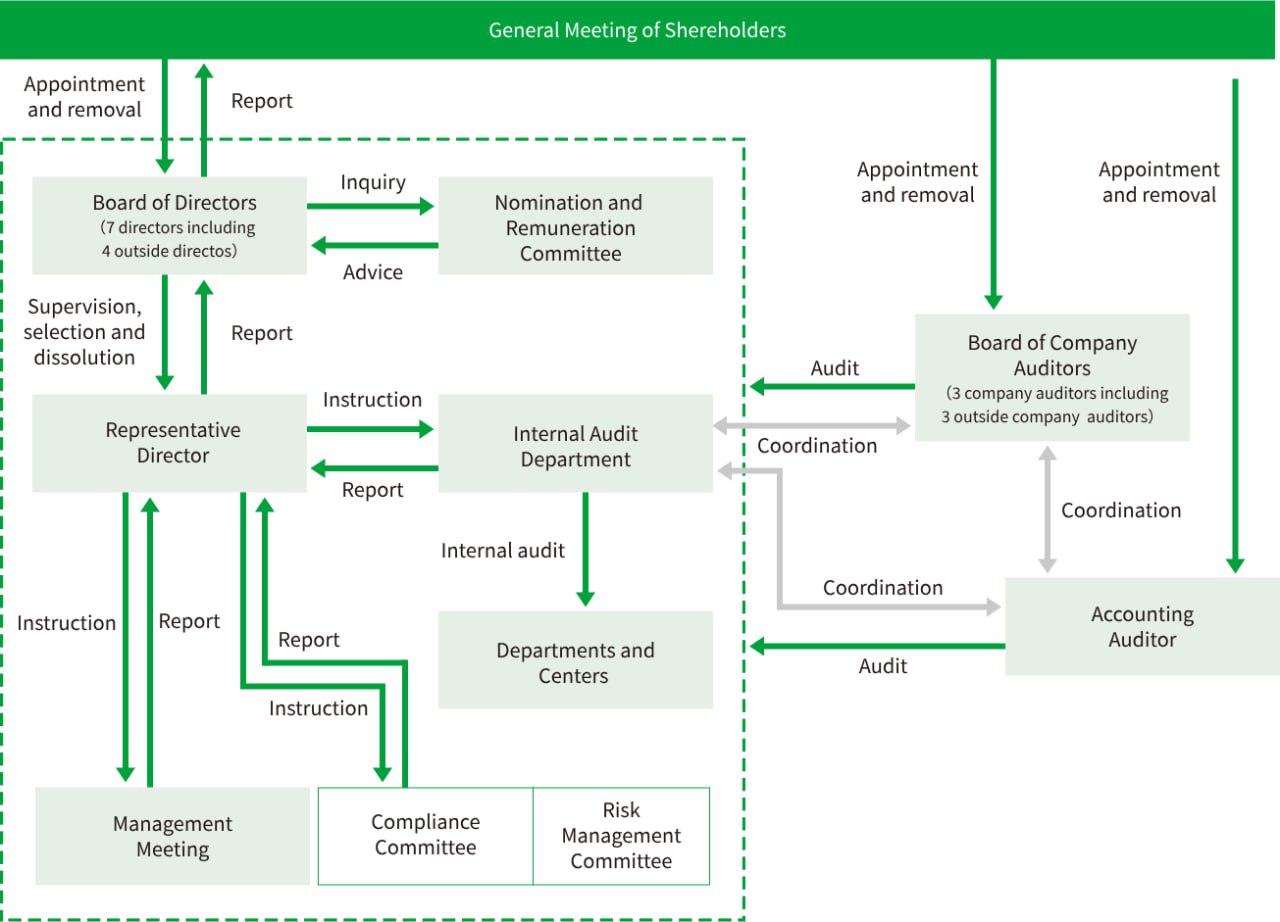
Our corporate governance structure is outlined below.
(a) Board of Directors
As of the date of this submission, the Company's Board of Directors consists of seven directors (including three outside directors), and is chaired by Hidehiko Ibaraki, Representative Director, Chairman and President.
Regular Board of Directors meetings are held once a month, in principle. In addition, extraordinary Board of Directors meetings are convened as necessary to decide on matters stipulated by laws and regulations or the Articles of Incorporation, as well as important management issues, and to supervise the execution of duties by the directors. Furthermore, all auditors attend Board of Directors meetings, ensuring a system in place to monitor the status of the directors' business execution.
(b) Management Meeting
The Management Committee consists primarily of three internal directors (including one Representative Director) and five executive officers. With the aim of facilitating swift and efficient decision-making, the committee deliberates on and reviews important management matters that affect the entire company, reviews progress on business performance, and shares various important updates. As a general rule, the committee meets twice a month and convenes as needed.
(c) Nomination and Remuneration Committee
To enhance the objectivity and accountability of the Board of Directors' functions regarding the appointment, removal, and compensation of directors, and to improve corporate governance, we have established a Nomination and Compensation Committee under the Board of Directors, with a majority of its members consisting of independent outside directors. The committee is chaired by Yoshiyuki Hirano, an outside director.
(d) Risk Management Committee
The Risk Management Committee is composed, with the President and Representative Director, full-time directors, and executive officers as its core members.
As an organization that deliberates on issues and countermeasures related to company-wide risk management in normal times, formulates measures to prevent various risks, and makes recommendations, the committee is, in principle, held once every quarter.
(e) Compliance Committee
The Compliance Committee is composed primarily of the President and Representative Director, full-time directors, and executive officers. It meets once every quarter to deliberate on the Company's compliance policies and various compliance-related issues, formulate measures to prevent recurrence in the event of an incident, and make recommendations.
(f) Audit Committee
The Audit Committee consists of three directors who are Audit Committee members, and meets in principle once a month and as necessary.
The Audit Committee deliberates and makes resolutions on matters including audit policies, audit plans, audit procedures, and the allocation of audit duties, and undertakes reviews of systems to ensure the effectiveness of audits conducted by Audit Committee members.
Audit Committee members attend key meetings, including meetings of the Board of Directors, and provide objective and impartial opinions. They audit the execution of duties by directors (excluding those who are Audit Committee members) by assessing the legality of business execution and examining the status of the Company's internal control systems.
Additionally, as necessary, they carry out audits through the review of important documents, on-site inspections of offices, and other investigative activities, thereby monitoring the execution of duties by business execution divisions.
Staff members are assigned to the Audit Committee Secretariat established within the Internal Audit Department to assist in ensuring the smooth performance of the duties of Audit Committee members, while further enhancing coordination with the internal audit function and other relevant departments.
The Audit Committee deliberates on the appointment of the external auditor, obtains necessary information and reports from directors (excluding those who are Audit Committee members), relevant internal departments, and the external auditor, and conducts an annual assessment of the appropriateness of such appointment.
Based on this assessment, the Committee evaluates and determines the appropriateness of the external auditor's performance of duties, audit system, and independence.
(g) Internal Audit Department
The Company has established an Internal Audit Department, which conducts internal audits of the Company and internal control audits relating to financial reporting pursuant to the Financial Instruments and Exchange Act (J-SOX), in accordance with an annual audit plan.
The results of internal audits are reported to the Representative Director, Chairman and President, and also to the Board of Directors, the Management Committee, and the Audit Committee.
(h) Accounting Auditor
Our company has entered into an audit service agreement with Deloitte Touche Tohmatsu LLC which conducts the accounting audit from an independent standpoint. The accounting auditor has no specific interest in our company.